Conversation traces, not call logs
1chat groups related LLM calls into a single multi-turn trace so product, support, and engineering can inspect the conversation that actually happened.
Unified LLM API for production teams
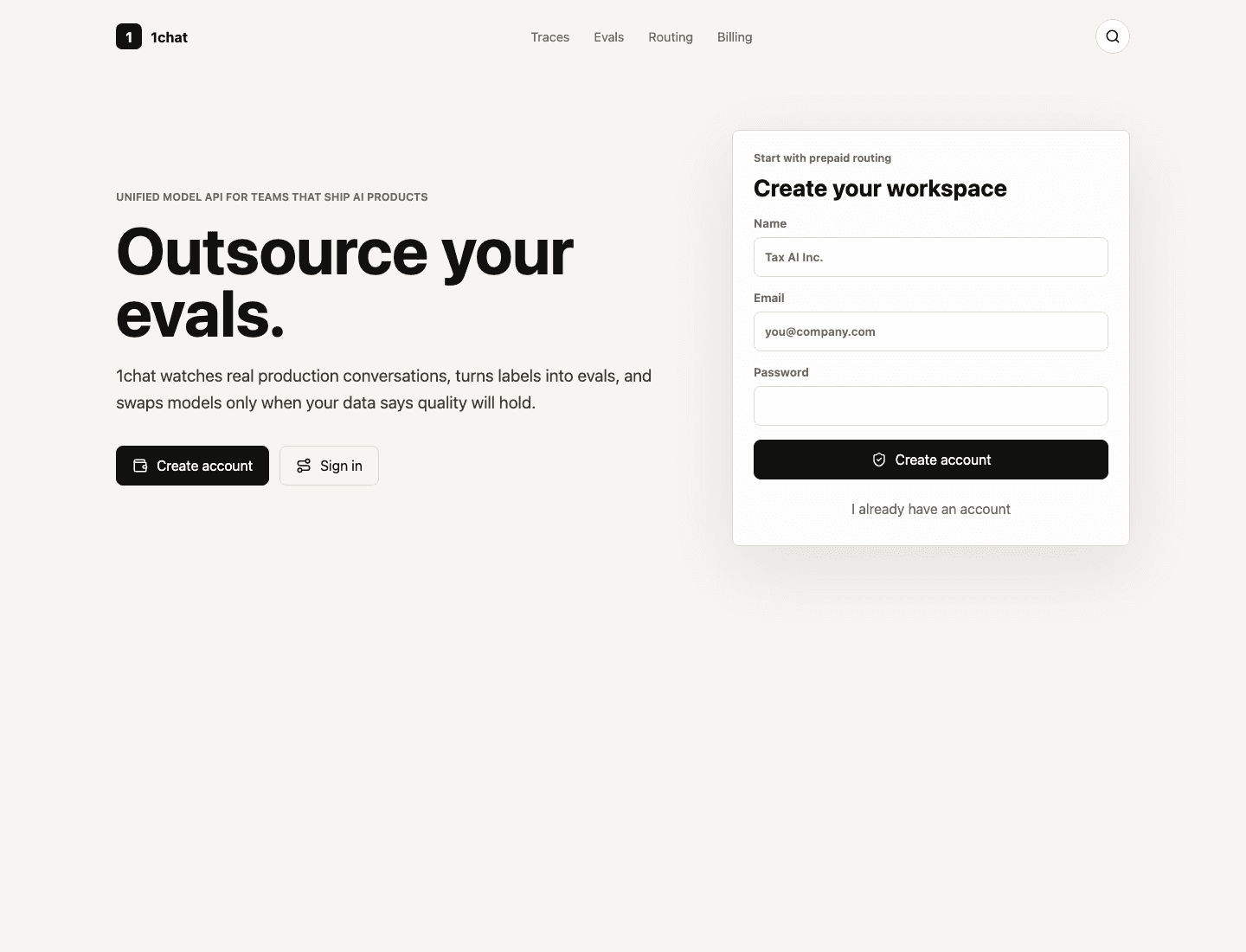
1chat is the drop-in model gateway that watches real conversations, turns feedback into eval sets, and swaps models when your own data says quality will hold.
Why 1chat exists
If your domain is tax prep, insurance claims, recruiting, tutoring, or clinical admin, the best model is not abstractly “best.” It is the model that preserves quality for your users, your prompt patterns, your tools, your edge cases, and your budget.
1chat groups related LLM calls into a single multi-turn trace so product, support, and engineering can inspect the conversation that actually happened.
Thumbs up, thumbs down, reasons, and inferred follow-up signals become regression datasets without asking your team to build an eval platform first.
Observe, shadow, conservative, balanced, and aggressive modes let cheaper models prove themselves against your data before traffic moves.
Every request reserves prepaid balance before provider execution. Customers can top up manually or use auto recharge, but never rack up a surprise bill.
How it works
The public API remains familiar, while the control plane stores traces, labels, costs, routing decisions, and candidate-model outcomes. Over time, 1chat learns which cheaper or faster models are good enough for each class of task.
Model routing detailsWhy 1chat
A compatible gateway that keeps existing SDK request shapes intact.
Conversation-level traces that group multi-call workflows into one inspectable timeline.
Labels and inferred follow-up signals that become customer-specific eval sets.
Routing modes that move traffic only when real production data supports the switch.
Billing
1chat reserves an estimated customer charge before the provider call, finalizes the exact charge when usage returns, and releases unused reservation. Failed calls do not become open invoices.